Motherhood and Family Care
To the LighthouseMotherhood and Family Care in To the Lighthouse is not merely a domestic backdrop but a demanding form of labor that shapes the family’s daily life and its moments of emotional connection. Through Mrs Ramsay, care includes making and mending, feeding guests, tending children’s fears, responding to illness, and trying to provide comfort beyond the household. The novel presents this work as creative and sustaining, while also exposing its costs: the mother who gathers others into safety can be left with little space to know or tend to herself.
Care as Practical Labor
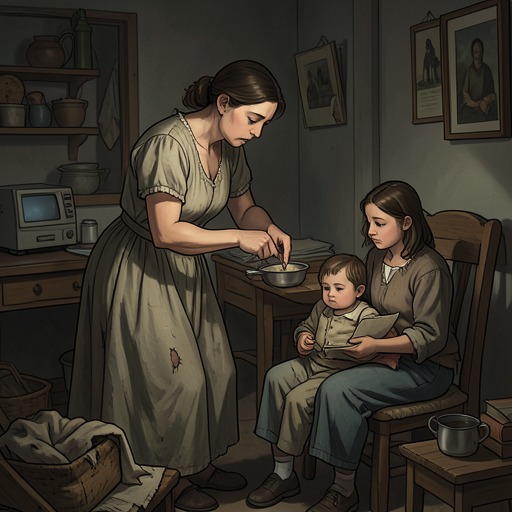
Mrs Ramsay’s care is made visible through ordinary tasks with particular recipients and consequences. She knits a reddish-brown stocking for the lighthouse keeper’s little boy, whose hip is threatened by tuberculosis, intending to send it with old magazines and tobacco. She imagines the keeper’s isolation on a rock, cut off from family and news during stormy weather, and treats these small provisions as a way of making confinement more bearable. The stocking must also fit: she measures it against James’s leg, asks him to stand still, and discovers that it is at least half an inch too short for its intended recipient. Care here is attentive and material, involving both sympathy for absent people and the precise work of making something useful.
That concern for comfort extends into the household’s arrangements and its wider community. Mrs Ramsay notices the shabby mat and flapping wallpaper, the doors left open, and the accumulating disorder produced by a busy family home. She also thinks beyond private domestic maintenance: the island has no hospital, and milk delivered to London homes can be dirty enough, in her view, that its sale should be made illegal. She imagines establishing a model dairy and a hospital, but the demands of raising her children leave her unsure when she could undertake such work. The contrast makes her practical care expansive in intention but constrained by the time and responsibilities assigned to her.
Her solicitude also reaches people whose troubles cannot be solved by a domestic gesture. A Swiss maid speaks of the beauty of the mountains at home, while her father is dying of throat cancer. Mrs Ramsay remembers the girl’s tears and the hopelessness of the illness; for a moment, the ordinary rhythm of scolding and demonstrating how to make a bed or open a window falls quiet. Her response registers both attention and helplessness: not every suffering can be met by the kind of care that mending, cleaning, or giving can provide.
The Mother’s Emotional Work
The novel gives maternal care a protective, almost generative force, but makes its effort equally plain. When Mr Ramsay arrives seeking sympathy and declares himself a failure, Mrs Ramsay redirects her attention toward him, trying to assure him that he is needed and belongs within the living world of the house. Her knitting continues as she offers reassurance; she imagines the rooms filled with life and makes the home feel, for him, like a place of warmth and refuge. James, standing beside her, experiences this support as a force that seems to rise around and protect him too. When Mr Ramsay finally leaves to watch the children play cricket, Mrs Ramsay folds inward, spent. The relief she has given is followed not by effortless contentment but by exhaustion.
The scene also shows the unequal structure of emotional care. Mrs Ramsay’s attention restores her husband, but she feels unable to tell him certain truths: she worries about the cost of repairing the greenhouse roof and suspects that his latest book may not be his best. She dislikes feeling finer than him, yet she also cannot be certain that what she says to comfort him is true. Care therefore asks her not only to act but to manage what may be spoken, smoothing over the gap between what her husband needs to hear and what she believes. Her success can make her seem powerful while narrowing the space left for her own candor.
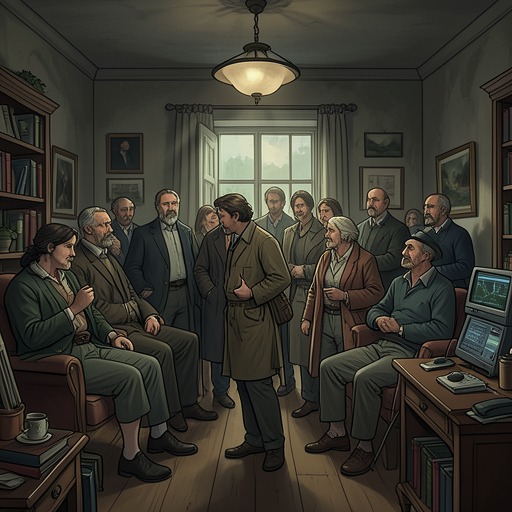
At dinner, this work takes a social form. With fifteen people expected, Mrs Ramsay worries that the guests are late and that the carefully prepared boeuf en daube will be spoiled if it is kept waiting. She organizes the seating, asks William Bankes to sit beside her, and begins again to draw a scattered company into a shared occasion. At first she feels outside the gathering, as if its members remain separate and the work of bringing them together belongs to her alone. She then resumes that effort, turning toward Bankes with concern for his loneliness and asking about the letters arranged for him in the hall. The meal becomes more than food: it is a fragile achievement of coordination, attention, and fellowship, dependent on labor that can disappear into the appearance of a naturally harmonious evening.
Childhood, Protection, and the Passage of Time
Mrs Ramsay’s care is also bound up with her resistance to children growing older. She loves James and Cam as they are, remembers their delight in small discoveries, and wishes she could keep them from losing the happiness of childhood. Her thoughts move through the children’s distinct qualities: James is sensitive, Andrew gifted at mathematics, Prue beautiful, and Rose skilled at making dresses and arranging tables and flowers. The attention is particular rather than interchangeable; she sees the children as separate people even as she longs to preserve their shared dependence on her.
Bedtime brings that care into direct contact with fear. Cam sees the boar’s skull on the wall as a threatening shape, and Mrs Ramsay covers it with her own shawl. She transforms its appearance in speech, describing it as a bird’s nest, a mountain, and a garden, and repeats images of lovely landscapes until Cam falls asleep. She then turns to James, who checks that the skull remains beneath the covering and asks whether they will go to the Lighthouse the next day. The shawl does not remove the object or settle the question of the trip; it gives the children a temporary shelter from fear, made through improvised storytelling and physical closeness.
Her wish to preserve childhood coexists with a troubling conviction that life contains suffering, death, and loneliness. She sees life as hostile and quick to seize its chance, and knows that her children will encounter ambition, misery, and isolation. Yet she tells herself they will be happy and urges them toward the future. In the same movement, she presses the expectation that people should marry and have children, even wondering whether she has pushed Minta toward marriage with Paul Rayley too quickly. Maternal care thus carries a tension: it seeks to protect the young from pain while preparing them for a life whose demands the mother herself fears.
Care, Gender, and Social Expectation
The novel makes visible how the work of maintaining family and social life is distributed. Mrs Ramsay’s knitting, child-rearing, hospitality, and emotional reassurance are treated as connected capacities, and she repeatedly becomes the person responsible for restoring a household or gathering. Her husband’s distress draws her into the role of comforter; an untended dinner threatens the evening’s coherence; children’s fears and needs interrupt the movement of her own thoughts. The image of male sterility set against her capacity to fill rooms with life captures the imbalance as she experiences it, while her exhaustion shows that this apparent abundance is produced by effort rather than by an inexhaustible maternal nature.
That effort is not limited to her own family, but the novel distinguishes sympathy from structural change. Mrs Ramsay can imagine sending supplies to a lighthouse keeper’s child and can be moved by a maid’s father dying far away; she can also recognize the absence of a hospital and the poor quality of milk. Yet the possibility of building public services is postponed by the demands of her children and the domestic world she manages. Care therefore appears at once as personal action and as a social burden: she notices needs that exceed the household, but the gendered responsibilities of the household restrict what she can do about them.
Continuity, Loss, and the Limits of Care
After Mrs Ramsay’s death, the abandoned house preserves traces of the labor that once made it a home. Mrs McNab finds clothes left in cupboards and recalls Mrs Ramsay in her grey gardening cloak, coming up the drive with the washing and a child beside her. The abandoned objects make care present as a history of ordinary acts, but they also mark the point at which those acts cannot simply resume. Mrs Ramsay will not return to wear the clothes or continue the routines associated with them.
The house itself is eventually rescued from decay by the labor of Mrs McNab and Mrs Bast, who arrive with brooms and pails after one of the young women writes that the family may come for the summer. They clean and scour, recover books and household objects from neglect, and work alongside builders; Mrs Bast’s son catches the rats and cuts the grass. This later restoration does not erase the earlier care or replace the person who performed it. Instead, it extends the novel’s attention to the often-overlooked work that keeps domestic spaces habitable. Motherhood and Family Care is therefore portrayed as life-giving but not limitless: it can shelter children, comfort adults, and create fellowship, yet it cannot defeat illness, stop time, or prevent loss. Its significance endures in the acts and spaces it has helped sustain.